- 615 Janopaul Ln. Modesto, CA
- info@stumpmfg.com
- (209) 596-4029
- Open Mon - Fri, 7am - 3:30pm
What fire chiefs and grant administrators need to know before applying — and which programs actually fund training tower and burn building construction.
Most fire departments pursuing a training tower or burn building assume FEMA’s Assistance to Firefighters Grant is the starting point. It’s the most recognized program in the fire service — and for good reason. AFG has distributed billions since 2001 to help departments acquire equipment, training, and protective gear. But here’s what catches a lot of departments off guard: AFG does not fund new construction. Training towers, burn buildings, and standalone training facilities fall outside AFG’s eligible cost categories.
That doesn’t mean federal money is off the table. It means the funding path for fire training infrastructure runs through different programs than the ones most departments apply to first. The major federal sources — AFG, SAFER, and Fire Prevention & Safety grants — each serve a specific purpose, and understanding which program fits which need is the difference between a funded project and a wasted application cycle.
Below is a list of the programs — federal, state, and alternative funding sources that departments have used to get training facilities and props built. This guide reflects program details as of April 2026. Grant programs update their eligibility criteria, funding levels, and application cycles regularly.
Before building your application, verify current requirements directly with the administering agency to make sure you’re working with the latest information.
AFG is the flagship federal program for fire departments, administered by FEMA through the Department of Homeland Security. It funds equipment, personal protective gear, training programs, and facility modifications — but not new construction. The distinction matters: installing an exhaust extraction system in your existing station qualifies; building a new training tower does not. Applications open through the FEMA Grants Outcomes (FEMA GO) portal, typically in late spring. Full program details are on the AFG program page.
That said, AFG can fund training-related expenses that support a fire training facility project indirectly. Live fire training courses, instructor certifications, and training equipment purchases all fall within AFG’s scope. If your department is building a training facility through other funding, AFG can potentially cover the training program costs that go with it.
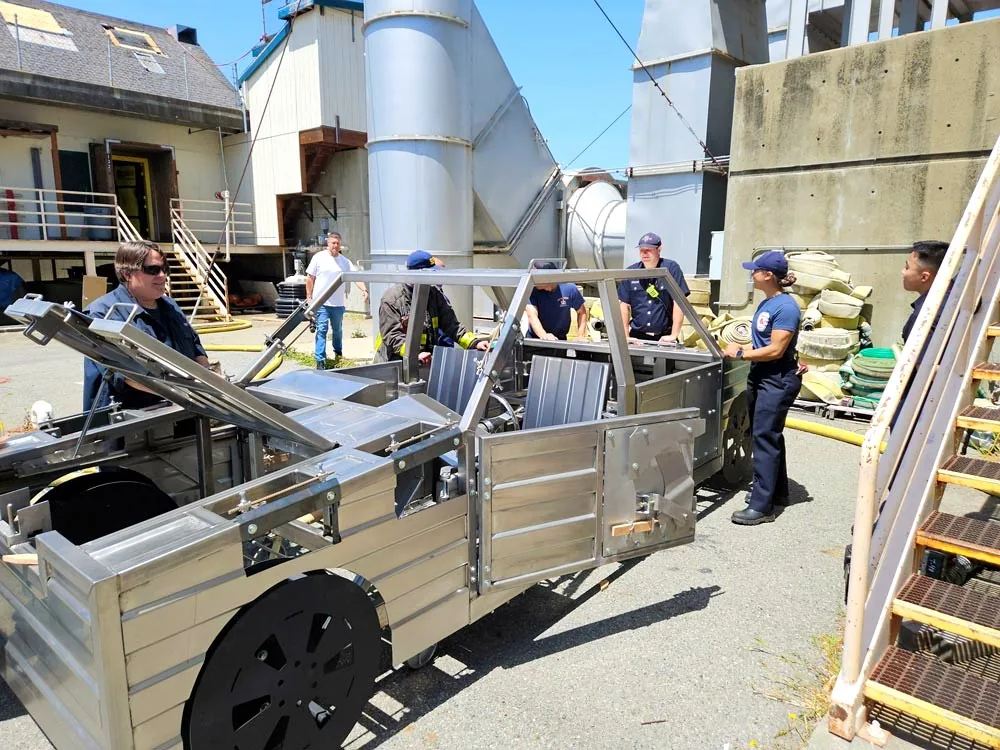
Fire training props and simulators also fall squarely on the AFG-eligible side of the line. FEMA classifies mobile and fixed fire training props — including vehicle fire simulators, Class B propane burn props, industrial hazard props, flashover simulators, forcible entry props, and rescue/smoke mazes — as equipment, not construction. They’re rated at medium priority in AFG’s funding hierarchy. For departments that can’t fund a full training tower through other sources, standalone props offer a way to significantly expand training capability using AFG dollars alone.
Cost share requirements are based on the population your department serves. Departments serving communities under 20,000 contribute 5% of the project cost. Between 20,000 and one million, the match rises to 10%. Over one million, it’s 15%. The match must be cash — in-kind contributions are not accepted. Applications are competitive, reviewed by panels of fire service personnel, and FEMA prioritizes departments that demonstrate clear operational need and limited existing resources.
SAFER funds one thing: people. Specifically, salary and benefits for firefighters — either hiring new personnel or retaining positions that would otherwise be cut. If your department needs to staff a new training facility, SAFER is relevant to your broader plan, but it won’t pay for the facility itself. SAFER is administered alongside AFG through the same FEMA GO portal, with application periods typically opening in late spring. See the SAFER program page for eligibility and current cycle details.
FP&S is AFG’s sister program, focused on fire prevention education, community risk reduction, and firefighter safety research. Funding runs around $36 million annually, with a maximum award of $1.5 million. FP&S doesn’t fund training infrastructure directly. That said, if your department can tie fire training props or a facility project to measurable safety outcomes — fewer training injuries, improved firefighter readiness, reduced line-of-duty exposure — there may be overlap with FP&S priorities worth exploring for complementary funding on the safety and prevention side of the project. Applications go through FEMA GO, and program specifics are on the FP&S program page.
So if the three big FEMA programs don’t cover new construction — though they do cover training props and simulators as equipment — where does the money come from for the structures themselves? A handful of programs at the federal and state level have been used by departments to fund training towers, burn buildings, and multi-use training complexes — they’re just not the ones most people look at first.
For departments in rural communities — defined as populations under 20,000 — the USDA Community Facilities Direct Loan & Grant Program is one of the strongest options. The program funds construction, renovation, and equipment purchases for essential community facilities, and fire training infrastructure qualifies. Unlike AFG, USDA Community Facilities covers the full scope — from training towers and burn buildings down to the props and simulators inside them — under a single application. Grant coverage scales with community size and income: the smallest communities with the lowest median household income can receive up to 75% grant funding, with the remainder covered by a low-interest direct loan.
Applications are accepted on a rolling basis from October 1 through September 30, processed through your state’s USDA Rural Development office. The Couderay Volunteer Fire Department in Wisconsin used this program to secure a $160,000 grant plus a $94,000 loan for a new fire training facility — a practical example of how rural departments can move from concept to funded project without relying on AFG.
State programs vary significantly, and the available funding can change year to year. A few examples that have directly funded fire training infrastructure:
New York’s Volunteer Fire Infrastructure & Response Equipment (V-FIRE) program has allocated $20 million specifically for construction, renovation, and facility purchases — with fire training towers explicitly listed as eligible projects. Individual awards are capped at $1 million. Virginia’s Department of Fire Programs offers grants specifically for construction, renovation, or repair of live fire training structures. Kentucky’s Fire Commission administers a Training Facility Grant specifically for fire training infrastructure — applications for FY2027 are currently open. California’s Volunteer Fire Capacity (VFC) program provides smaller awards ($500–$20,000) with a 50/50 match requirement — not enough for facility construction, but enough to fund individual training props or simulators that immediately expand a department’s training capability.
Your state fire marshal’s office or state fire chiefs association is the best starting point for identifying what’s available in your jurisdiction. These programs have different application cycles, eligibility criteria, and match requirements — and they change more frequently than federal programs. The USFA State Fire Agency Contacts Directory provides direct contact information for every state’s fire marshal and training offices. See the state-by-state directory below for links to specific state programs.
Federal earmarks — now called Community Project Funding — have returned as a viable path for fire training infrastructure. These are line items requested by members of Congress for specific projects in their districts, funded through the annual appropriations process. Earmarks can cover the full project scope — structures, props, simulators, and site work — with no programmatic restrictions on what counts as construction vs. equipment. The Sterling and Rock Falls fire departments in Illinois secured $825,000 through this process for a regional fire training tower project.
The path to an earmark typically requires your department to work with your U.S. representative or senator’s office, submit a formal project request during the earmark request period (usually early in the calendar year), and demonstrate community support and project readiness. Current request forms and deadlines are posted on the House Appropriations Committee’s Community Project Funding page. It’s a political process, not a competitive grant application — your project’s strength depends on your relationship with your representative and the project’s alignment with their priorities.
Every state administers its own fire department grant programs through the state fire marshal’s office, forestry division, or fire commission. Programs change annually — the links below point to each state’s current grant or fire services page. For states where a specific grant portal isn’t available online, the link goes to the state fire marshal or fire training office. The USFA State Fire Agency Contacts Directory is a reliable backup for finding the right contact in any state.
Not every training facility is built on grant money. Some of the most successful projects use funding structures that don’t involve a grant application at all.
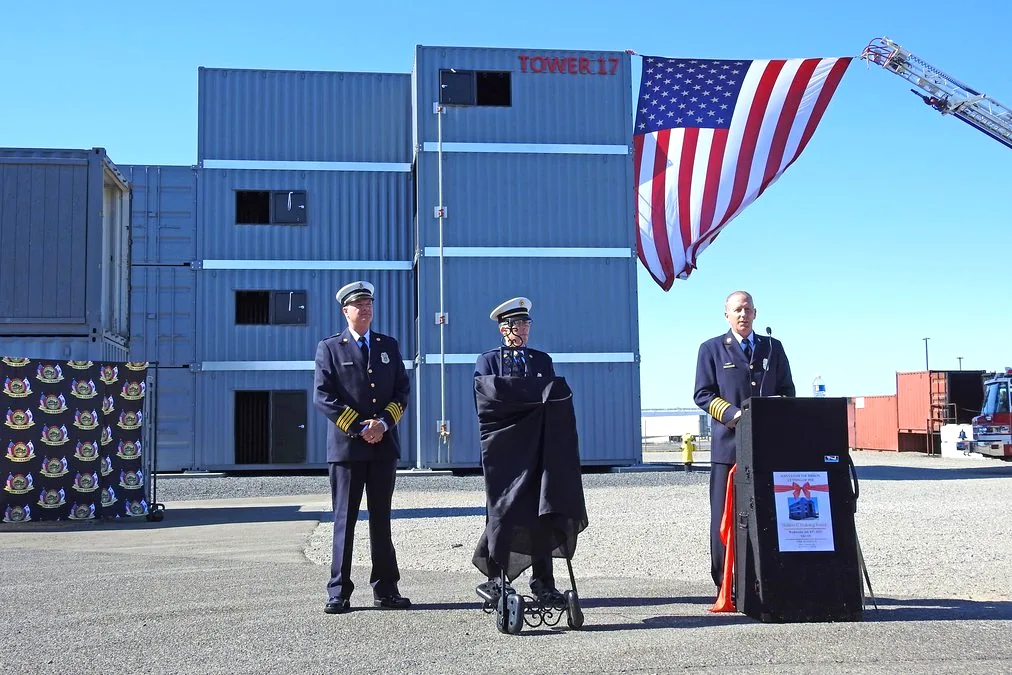
When no single department can justify the full cost of a training facility, a Joint Powers Authority (JPA) or intergovernmental agreement lets multiple agencies pool their budgets into a shared project. This is how Stanislaus County’s Tower 17 — a $1.19 million four-story tactical training tower in Ceres, California — was built. Five agencies contributed through a formal MOU: the cities of Ceres, Modesto, and Turlock, the Stanislaus Consolidated Fire Protection District, and the Stanislaus County Regional Fire Authority. No grant application. No waiting on a federal award cycle. The agencies negotiated their shares, signed the agreement, and built it.
The Heartland Fire Training Facility in San Diego County uses the same model with eight participating agencies, funding the facility through annual fees calculated by each agency’s on-duty personnel count. JPAs work especially well in metro or suburban regions where multiple departments operate in close proximity and share training needs.
The Stanislaus County project included a $250,000 contribution from the Yosemite Community College District — home to Modesto Junior College’s Regional Fire Training Center. That’s not charity. Community colleges with fire science or fire technology programs have a direct financial interest in training facilities: when they run accredited courses at a training site, they generate FTES (Full-Time Equivalent Student) enrollment that the state reimburses. California’s ARTP (Accredited Regional Training Program) system formalizes these partnerships between colleges and fire agencies.
If your region has a community college with a fire science program, they may be a willing funding partner — especially if the facility can serve as a satellite training site for their program. It’s a model that’s underused because most fire departments don’t think to approach the education side.
In growing communities, fire protection districts can levy development impact fees on new construction — and “training grounds and structures” are explicitly listed as eligible facilities in many jurisdictions. This isn’t a one-time funding source like a grant. It’s an ongoing revenue stream tied to new development in your service area. It won’t fund a facility overnight, but departments in high-growth areas have used accumulated impact fee revenue to partially or fully fund training infrastructure over time.
Grant programs differ, but the applications that get funded tend to share a few things in common — regardless of the source.
Start with the need, not the wish list. Grant reviewers evaluate whether your department has a documented, defensible need — not whether you want a nice facility. Your application should reference your department’s risk assessment, call volume data over at least three years, training gaps documented in after-action reports, and any NFPA compliance issues that a training facility would address. Departments that reference NFPA 1403 requirements for live fire training and can show that their current training options are inadequate or nonexistent consistently score higher.
Get specific about scope and cost. Vague applications fail. If you’re requesting funding for a fire training tower, your application should include preliminary specifications: height, number of stories, training scenarios supported, NFPA 1403 compliance details, site preparation requirements, and a detailed cost estimate. This is where working with a manufacturer early in the process matters — not to sell a specific product, but to produce the technical documentation that gives your application credibility. A grant reviewer reading “multi-story training tower” processes that differently than one reading “four-story NFPA 1403-compliant burn building with integrated smoke management, Class A and Class B prop capability, and modular room configurations supporting interior attack, search and rescue, and ventilation training scenarios.”
Build a regional case when possible. Programs like USDA Community Facilities and state-level grants look favorably on projects that serve multiple jurisdictions. A training facility shared between three or four departments in a county strengthens the application’s impact narrative and spreads the cost-share burden. The Sterling/Rock Falls project in Illinois and the Tower 17 project in Stanislaus County both succeeded because they were framed as regional assets serving multiple departments — not single-agency facilities.
Don’t submit the same narrative everywhere. FEMA’s narrative development guide specifically warns against template applications. Every program has different priorities, and reviewers can tell when a narrative was written generically and pasted across multiple applications. Tailor each submission to the specific program’s evaluation criteria — they’re published in the Notice of Funding Opportunity (NOFO) for federal programs and the Request for Applications (RFA) for state programs.
For additional guidance on finding and applying for fire service grants, FireGrantsHelp.com and Grants.gov are useful starting points for tracking open application periods.
Stump Construction & Manufacturing has fabricated NFPA 1403-compliant fire training structures for departments across the country, and several of those projects have been partially or fully grant-funded. The funding source doesn’t change how we design or build a structure — but it changes what a department needs on paper before they submit an application.
For departments putting together a grant application, our engineering team can provide preliminary specifications, scope documents, and detailed cost estimates — the level of detail that grant reviewers actually want to see. It’s not a sales conversation. It’s the technical documentation that turns a vague project description into a fundable one.
We build both sides of the funding equation: the training structures that require USDA, state, or earmark funding — and the fire training props and simulators that qualify as AFG-eligible equipment. Whether your department is exploring grant funding for a custom burn building, live fire training structure, or standalone props like vehicle fire simulators and Class B propane burn props, we can help you define the project scope before you write the application — so the numbers and specs in your grant match what you’ll actually build.
Whether you're applying for a grant, building a JPA cost-share, or combining funding sources — our team can provide the specifications and scope documentation your project needs. No commitment required — just a conversation about what's possible for your department.
Or call us directly: (209) 596-4029
Mon–Fri, 7 AM – 3:30 PM PT
Can AFG grants be used to build a fire training tower?
Not for the tower itself — AFG doesn’t fund new construction. Training towers and burn buildings are considered construction projects. However, AFG does fund fire training props and simulators as equipment purchases — vehicle fire simulators, Class B propane props, flashover simulators, forcible entry props, and similar training aids all qualify. AFG can also fund training program costs (courses, certifications) that complement a facility built through other sources. For the structure itself, look at USDA Community Facilities (rural departments), state-level programs, or Congressional earmarks.
What’s the typical cost share for fire training grant programs?
It varies by program and community size. For AFG-eligible expenses, departments serving populations under 20,000 contribute 5%, while departments serving 20,000 to one million contribute 10%. USDA Community Facilities grants can cover up to 75% of project costs for the smallest and lowest-income rural communities. State programs set their own match requirements — New York’s V-FIRE program and Virginia’s live fire training structure grants each have specific match formulas. Check the specific program’s NOFO or RFA for current requirements.
How long does the grant process take from application to funded project?
Federal grant cycles typically run 12 to 18 months from application deadline to award notification. After the award, departments usually have 12 to 24 months to complete the project, depending on the program. State programs vary — some move faster, some slower. Congressional earmarks follow the federal appropriations calendar, which can stretch over a year. Plan for at least two years from initial application to project completion, and start the manufacturer conversation early so your specs are ready when the funding arrives.
Should we get project specs before or after applying for a grant?
Before. Grant applications with detailed scope, specifications, and cost estimates consistently score higher than those with vague project descriptions. Working with a manufacturer during the application phase gives you the technical detail that reviewers want — height, floor count, training scenarios supported, NFPA 1403 compliance specifics, and an itemized cost breakdown. You’re not committing to a purchase by getting specifications; you’re making your application competitive.
Can we combine multiple grant sources for one project?
Yes, and many departments do. A common approach combines a USDA or state grant for the primary construction cost with AFG funding for training props, simulators, and program costs that go with the facility. Some departments layer USDA Community Facilities grants with state fire training grants and local matching funds. The key is making sure each funding source covers eligible expenses under its own program rules — you can’t double-dip on the same cost, but you can fund different project components through different programs. A training tower funded through USDA and vehicle fire simulators funded through AFG is a clean split that works.
What if we can’t get a grant — are there other ways to fund a training facility?
Yes. Many training facilities are built without traditional grants. Joint Powers Authorities let multiple agencies pool their budgets through a formal agreement — the Tower 17 project in Stanislaus County, California was funded this way by five agencies sharing the $1.19 million cost. Community colleges with fire science programs are another source — they have a financial incentive to partner on training facilities that generate student enrollment. And in growing communities, development impact fees collected from new construction can accumulate into a significant funding pool over time. Grants are one path, but they’re not the only one.
Does Stump help with the grant application itself?
We don’t write grant applications — that’s a specialized skill, and departments should work with a grant writer or their state fire chiefs association for application support. What we do provide is the technical backbone of the application: preliminary engineering specifications, detailed scope documents, and accurate cost estimates for fire training structures. These are the documents that turn a general project description into a credible, fundable proposal. We’ve supported departments through this process on past grant-funded projects and can do the same for yours.