What fire departments need to know before commissioning a live fire training structure — and how to choose a manufacturer who builds to NFPA 1403 standards from the ground up.
Live fire training is controlled fire training that uses real flame to simulate conditions firefighters encounter on the job. Done right, it builds skills that no mechanical simulator can replicate — heat reading, smoke navigation, hose line management under actual thermal load, and coordinated suppression in realistic burn environments.
These training exercises require structures that perform consistently across hundreds of iterations. That means non-combustible construction, engineered smoke distribution, and thermal monitoring systems that keep training safe, documented, and repeatable.
Stump Construction & Manufacturing builds fire training towers and props that meet or exceed NFPA 1403 requirements — designed with departments, sized to budgets, and delivered ready to train.
Every Stump live fire training structure is custom-designed and engineered to your department’s specifications. No two projects are identical — we work from your training objectives, site conditions, and budget to engineer a structure that performs from day one.
Standard configurations include:
We also build custom burn buildings as standalone structures for departments focused on core suppression training.
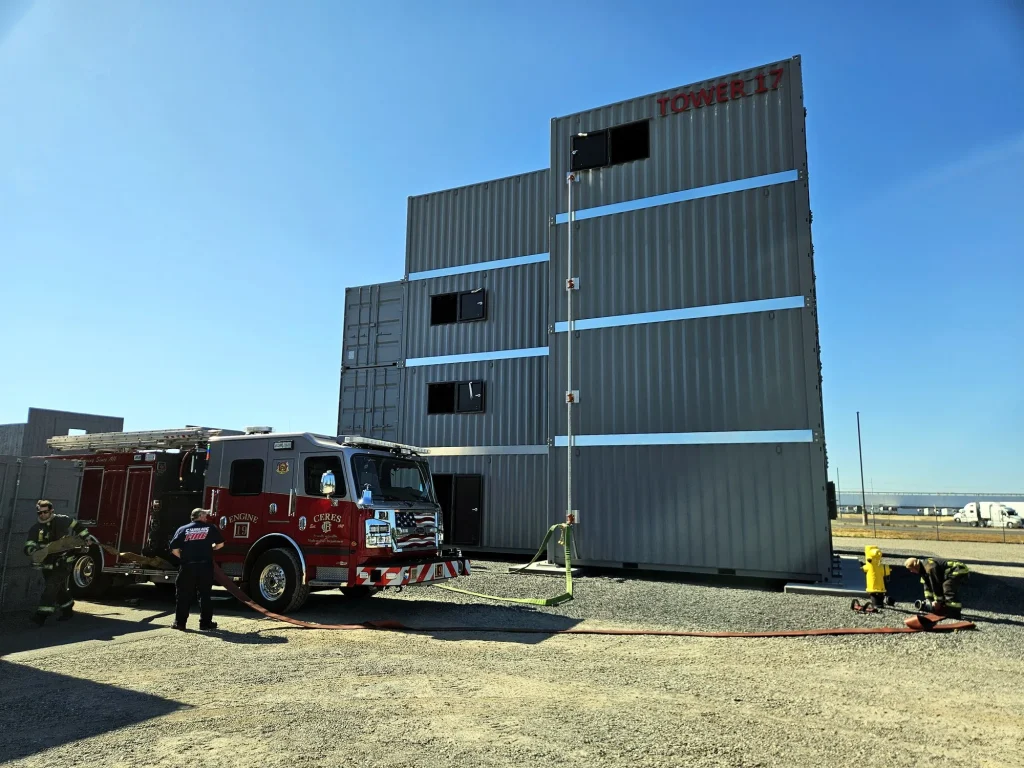
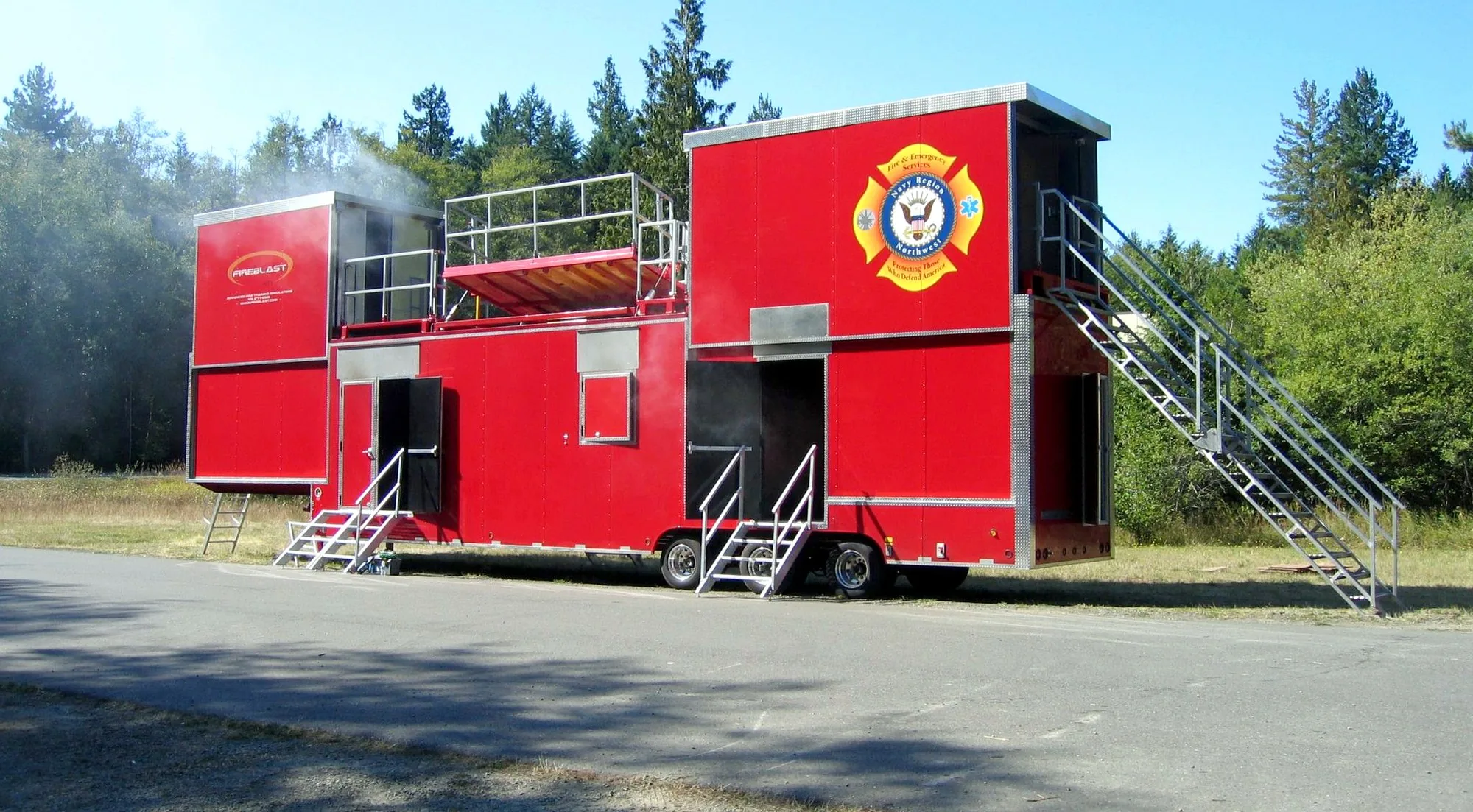
NFPA 1403 is the adopted standard in most jurisdictions and required by insurers and accreditation bodies for live fire training. It governs structure integrity, fuel management, water supply, safety officer requirements, and post-fire inspection protocols.
Every structure Stump builds is engineered to meet NFPA 1403 from the ground up — not retrofitted after the fact. That means non-combustible materials rated for repeated thermal exposure, integrated heat monitoring, engineered ventilation, and ventilation systems designed to meet your authority having jurisdiction (AHJ) requirements.
When you buy from a fabricator who builds the structure, you get an engineer who understands why every specification is there — not a broker who sources components and assembles a compliance checklist after the fact.
See our full NFPA 1403 compliance guide for what the standard requires and what to ask any vendor before you sign.
Live fire training structures from Stump MFG support a wide range of tactical training drills:
Not every scenario applies to every structure. We design around your training priorities — then engineer in the flexibility to expand as your program grows.
Stump handles the full project lifecycle — from initial conversation to post-installation support.
Ready to start? Tell us what you’re training for and we’ll tell you what’s possible within your budget and timeline.
Tell us about your project. No sales process. No follow-up sequence. Just a direct conversation.
Or call us directly: (209) 596-4029
Mon–Fri, 7 AM – 3:30 PM PT
Our structures support both Class A fires (wood, paper, natural materials) and, with the right prop integration, Class B fires (propane-fueled flames). Class A burn buildings are the most common — they allow NFPA 1403-compliant live fire training with fuel loads your department controls. Class B props add gas-fueled scenarios for accelerated training drills. We design and fabricate both.
Yes. Most of our towers and larger burn buildings are designed around multi-scenario use — room fires, hallway suppression, confined space, roof operations, and more. We work from your training program and build in the flexibility to support what you actually run, not just a static layout.
Full project. Stump handles design, engineering, fabrication, delivery, and on-site assembly across the US and internationally. You’re not coordinating between a designer, a fabricator, and a logistics company — it’s one team, one contract.
Most vendors in this space are brokers who source components and assemble compliance paperwork after the fact. Stump is a fabrication shop. We build the structure in-house using our own equipment — which means we control tolerances, material quality, and schedule. You also get an engineer who understands why every spec is there, not a sales rep with a catalog.
We’ve shipped and assembled structures across the US and internationally. High-value, complex projects justify travel. Logistics are coordinated from our Modesto facility — distance isn’t a barrier for the right project.
In most cases, yes. Because Stump fabricates the structure, we retain the engineering documentation. Modifications — adding burn rooms, integrating new prop types, expanding to an additional story — are feasible and something we can quote once you’ve trained on the original build.